Chelsea Creek’s Tugboat Crews Step Into the Spotlight |
Chelsea Creek’s working waterfront takes the spotlight as local tugboat crews help support safe ship movement ahead of Sail Boston 2026. |
Chelsea residents know that the waterfront is never just scenery. Along Chelsea Creek, the movement of ships, fuel, cargo, tugs, bridges, and working crews is part of the city’s daily rhythm. This summer, with Sail Boston 2026 preparing to bring tall ships and naval vessels back to Boston Harbor, that behind-the-scenes maritime work is getting a rare moment in the spotlight. Sail Boston’s official site says the Tall Ships return to Boston Harbor from July 11 through July 16, 2026, and that Boston is an official port of Sail250, a global gathering tied to the 250th anniversary of the founding of the United States.
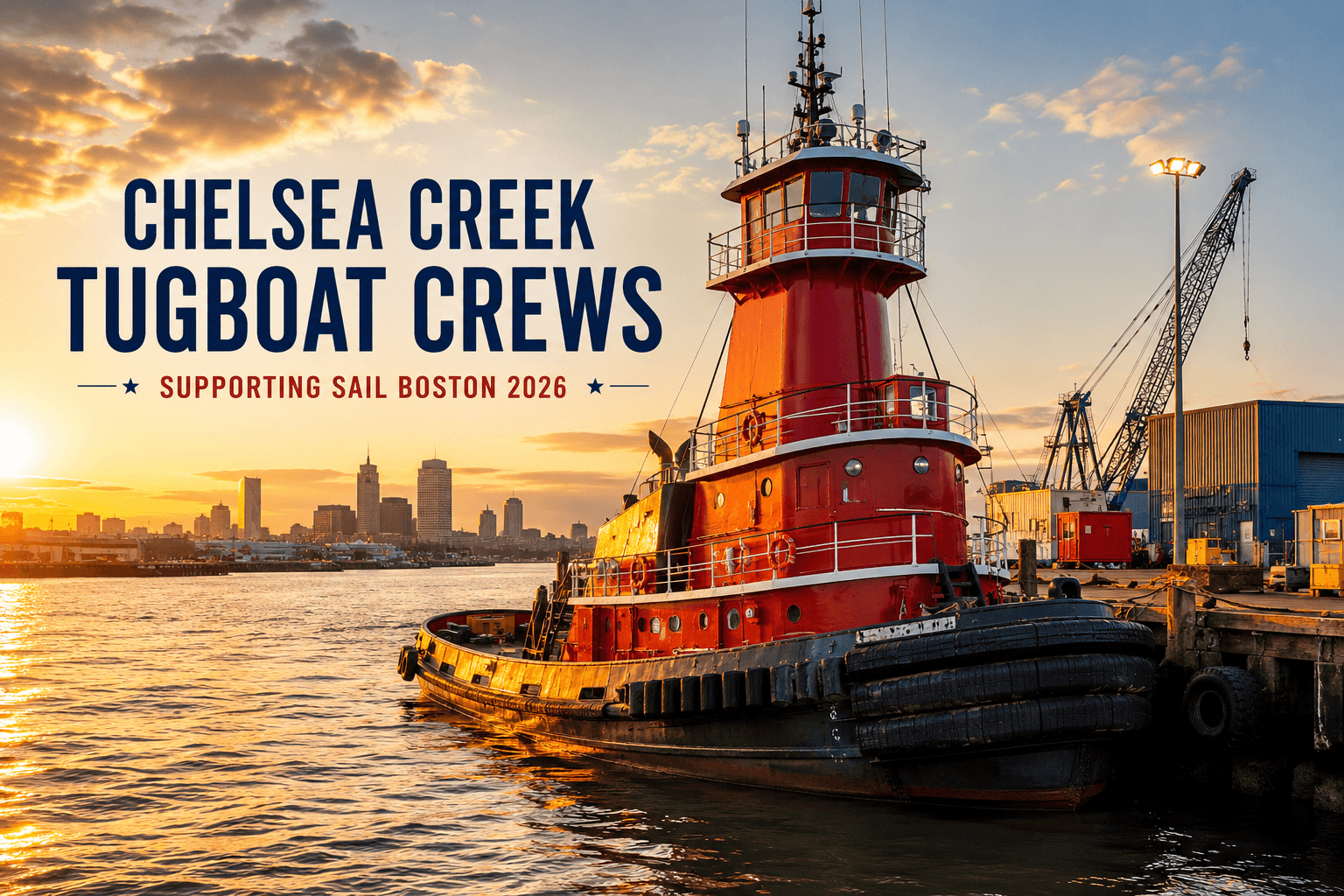
A June 24 story from ROCK 92.9 highlighted the crews who help move and guide large vessels in Boston Harbor, including the tugboat Justice, which operates from Chelsea Creek. The report described the Justice as a 98-foot tugboat built in 2009 with 5,400 horsepower from twin Rolls-Royce engines, and said its crew supports ship operations involving vessels such as the Iver Prosperity.
That detail gives the story special local meaning. For many people watching Sail Boston, the tall ships will be the stars: high masts, international crews, dramatic views, and crowded waterfronts. But large harbor events also depend on people whose work is less visible from shore. Tugboat crews, docking pilots, engineers, and deckhands help make sure vessels move safely through a harbor that already includes ferries, commercial traffic, recreational boats, whale watches, and sightseeing vessels.
The Boston Globe’s profile of the Justice placed Chelsea Creek at the center of that working-waterfront story. The Globe reported that the Justice guided the Iver Prosperity as the tanker backed out of the narrow Chelsea Creek on its way to St. John, New Brunswick, and noted that ships requiring tug assistance must have a licensed docking pilot on board to communicate with the tugs. The Globe also reported that tugs routinely help move two-thirds of the Northeast’s oil supply through Chelsea Creek, sometimes with very little room to spare.
The work is highly technical. Capt. William F. Potter of Boston Harbor Docking Pilots told the Globe that docking tall ships is complicated because many sailboats are underpowered and their rigging or underwater features can interfere with docking maneuvers. For readers who mostly see tugboats from a bridge, shoreline, or traffic backup near the creek, it is a useful reminder: those compact-looking vessels are doing careful, skilled work in tight spaces.
A Working Waterfront Story
The Justice itself has a documented working history. Tugboat Information lists the Justice as built in 2009 by J.M. Martinac Shipbuilding Corporation in Tacoma, Washington, for Boston Towing and Transportation Company, and says it later assumed ship-assist duties in and around Boston, the Cape Cod Canal, and Buzzards Bay. Professional Mariner, in a 2010 article about Boston Towing’s escort tug fleet, described the Justice as a 98-foot ASD tug designed for escort and assist work, with 5,400 horsepower and a 70-ton bollard pull.
Sail Boston will bring that kind of harbor coordination into a much larger public setting. The official Sail Boston schedule lists the Meet Boston Parade of Sail for Saturday, July 11, from 9 a.m. to 4 p.m. in Boston Harbor, with vessels parading from Broad Sound into the main harbor channel before heading to assigned berthing locations. The Parade of Sail page says more than 50 ships are expected to participate, with public viewing from places including Castle Island, the Seaport District, the Boston Waterfront, East Boston, the North End, and Charlestown.
Safety planning is also part of the story. The U.S. Coast Guard’s temporary final rule for Sail Boston says the event runs from July 11 through July 16, with tall ships arriving and anchoring in Broad Sound on July 10 before the July 11 Parade of Sail into Boston Harbor. The rule establishes temporary regulations, including safety and security zones and anchorage-ground suspensions, to promote safe navigation and public safety during the event.
For Chelsea, the positive local angle is clear. Chelsea Creek is often discussed in terms of industry, traffic, pollution, infrastructure, and environmental justice. Those issues are real and important. But the creek is also a working waterfront where skilled maritime labor happens every day. Sail Boston gives residents a chance to see the larger harbor celebration and also recognize the local crews connected to Chelsea Creek who help keep that harbor moving.
As the tall ships arrive, the spotlight will naturally fall on the vessels with the tallest masts and the biggest crowds. But just beyond the postcard view is another story: pilots, captains, engineers, and tug crews doing precise work in real time. Some of that work begins close to home, right here on Chelsea Creek. |
0 Comments
Join the conversation
Be the first to comment
Share your thoughts above.