
Brigham Nurses Return to Work After Strike and Lockout |
More than 4,000 nurses are back at Brigham and Women’s Hospital, but the contract dispute with Mass General Brigham remains unresolved. |
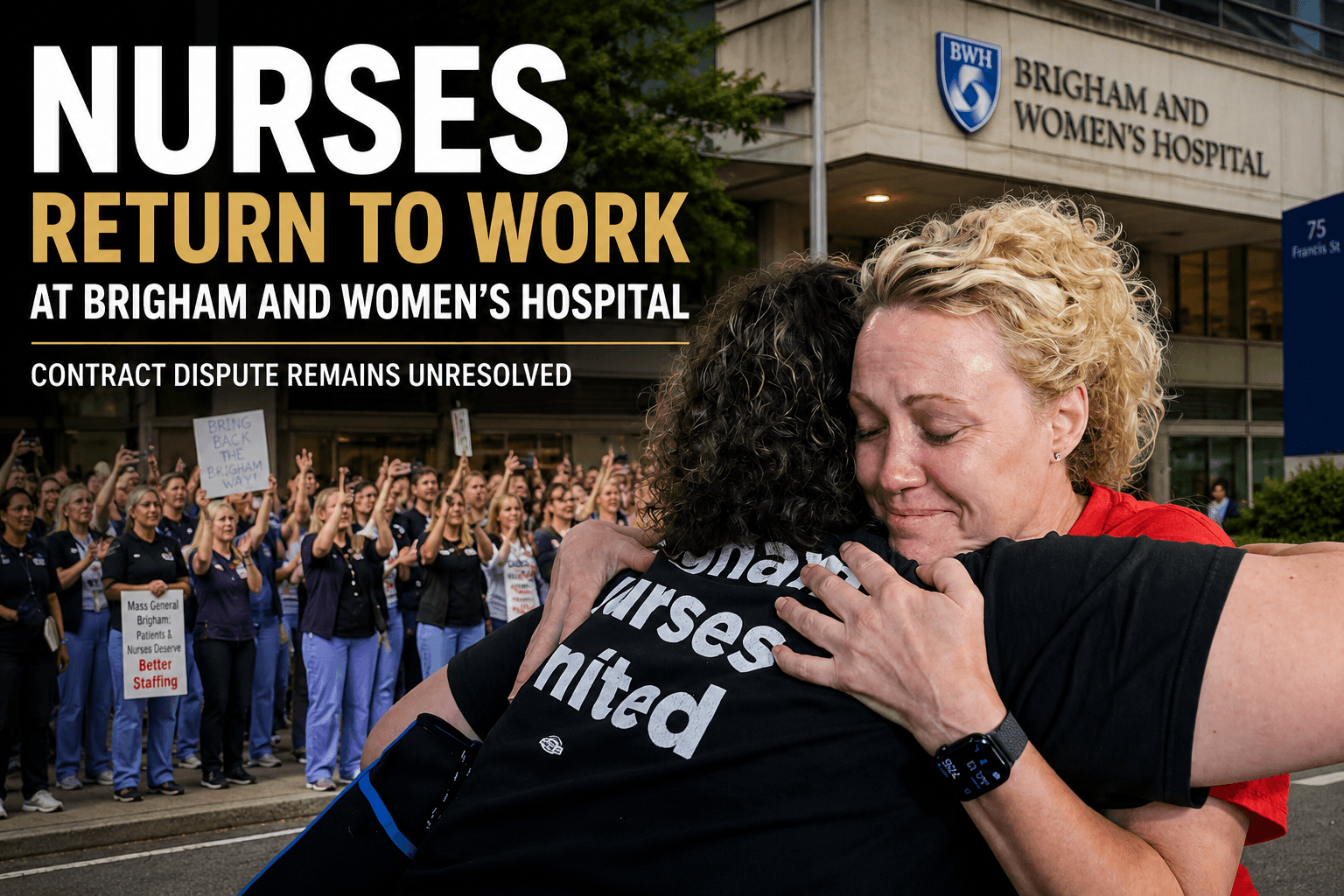
For patients, staff, and neighbors around Boston’s Longwood Medical Area, Monday brought a visible shift at Brigham and Women’s Hospital: more than 4,000 registered nurses returned to work after a one-day strike followed by a four-day lockout.
The nurses came back to their regular shifts on Monday, July 13, after what the Massachusetts Nurses Association described as the largest nurse strike and lockout in Massachusetts history. The return followed several tense days outside the hospital, where nurses had picketed after walking off the job on Wednesday, July 8, and then were not allowed back inside when the strike ended the next morning.
The dispute is not over. According to the Massachusetts Nurses Association, Brigham nurses remain without a new contract after months of bargaining with Mass General Brigham, the hospital’s parent system. The union says nurses are continuing to push for a contract that addresses recruitment, retention, wages, health insurance, temporary staffing, and patient care protections.
Hospital leaders, meanwhile, have said the hospital remained open and prepared throughout the work stoppage. Brigham and Women’s Hospital’s public update page said the work stoppage was expected to run from July 8 until July 13 at 7 a.m., and that the hospital brought in qualified temporary nurses as part of its emergency preparedness plan. The hospital also stated that care and operations were mostly continuing as normal during the work stoppage.
The immediate flashpoint came after the union’s planned 24-hour strike. Nurses attempted to return to work Thursday morning, but the hospital continued the work stoppage through Monday. Brigham said this was tied to the need to meet temporary staffing contracts that covered a five-day period. CBS Boston reported that nearly 1,300 replacement nurses had been contracted to cover the strike period.
At the center of the disagreement are familiar but deeply important issues in Boston health care: compensation, benefits, staffing, and how hospitals retain experienced nurses in a high-cost region. WBUR reported that the contract dispute centered partly on compensation, with nurses seeking cost-of-living raises while the hospital emphasized existing annual step increases and the cost of additional raises. WBUR also reported that the two sides disagreed over health insurance costs and the use of temporary workers.
For many Boston residents, the story is about more than labor negotiations. Brigham and Women’s Hospital is one of the region’s best-known medical centers, located at 75 Francis Street, and serves patients from across the city, the state, and beyond. Any work stoppage at a hospital of that size carries community concern, especially for patients with scheduled appointments, families visiting loved ones, and neighbors navigating picket lines, traffic, and uncertainty.
The nurses’ return may ease some of that uncertainty, but it does not close the chapter. The Massachusetts Nurses Association said Brigham nurses are continuing to seek a contract that improves recruitment and retention, provides competitive wage increases, protects health insurance options, limits reliance on temporary staffing, and invests in frontline care. Those are the union’s stated goals, not a finalized agreement.
A related labor action also continued beyond the nurses’ return. The union said approximately 450 Mass General Brigham Home Care clinicians remained on strike through Tuesday, July 14, as they continued seeking their first union contract. The home care bargaining unit includes clinicians such as nurses, therapists, social workers, and dieticians, according to the union.
As of Monday’s return, the most practical takeaway for patients was straightforward: Brigham nurses were back inside the hospital, and Brigham and Women’s Hospital had advised patients to continue coming to scheduled appointments unless contacted directly by their care team. For the broader community, the story remains one to watch because the underlying contract dispute remains unresolved.
In a city where hospitals are major employers, care providers, and neighborhood anchors, the Brigham work stoppage was a reminder that labor negotiations inside large health systems can quickly become community news. The nurses are back at the bedside, but both sides still face the harder task of reaching an agreement that can hold. |
4 Comments
Join the conversation
Those nurses on the picket line in the heat all week deserved better than a lockout. Respect.
1,300 replacement nurses in 5 days? that had to cost a fortune. just pay the real nurses fairly and skip all this
southie_salLooked it up and those travel nurse agencies charge hospitals something like 3-4x the regular rate. So yeah, the math on that lockout decision is real questionable.
My mom had an appointment at the Brigham last Thursday and we had no idea what to expect. Stressful week for a lot of families.