
35 Years After Receivership: How Chelsea Rebuilt Itself |
A Sept. 16 panel brought together Chelsea's first four city managers — for the first time ever in one room — to trace the city's arc from a $10 million financial collapse to national recognition for good government. |
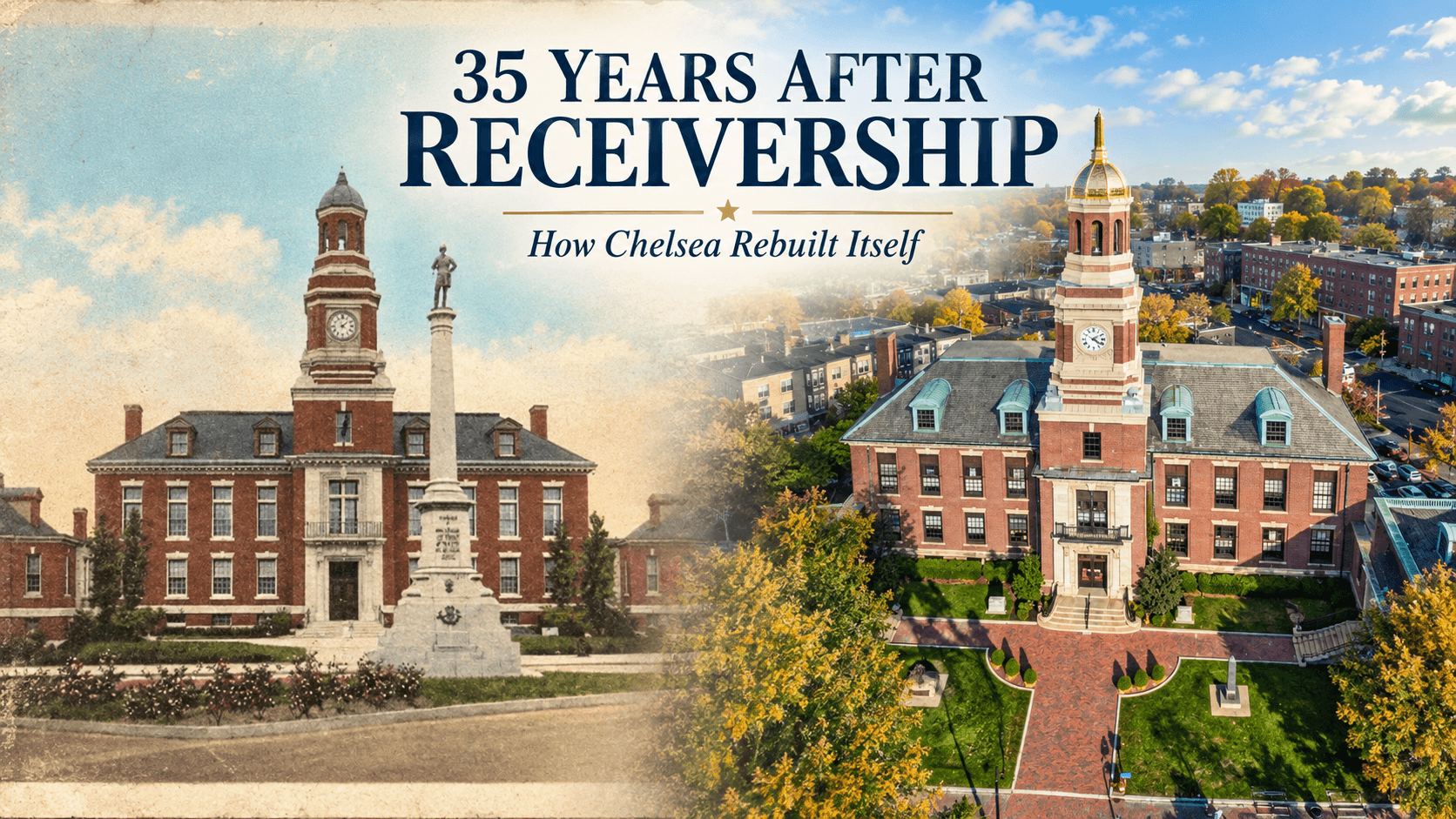
On September 16, 2026, at 6 p.m., Chelsea's four post-receivership city managers took the stage together for the first time — Guy Santagate, Jay Ash, Thomas Ambrosino, and current City Manager Fidel Maltez, seated side by side at the Chelsea High School auditorium for a panel called "Chelsea: Then and Now." More than 150 attendees were expected, enough that organizers moved the event from Chelsea's City Hall Council Chambers to the larger auditorium at 299 Everett Avenue, first announced on the city's official event page. Massachusetts Municipal Association Executive Director Adam Chapedelaine moderated, and Stephen McGoldrick, former chief of staff to the state receiver, opened with an account of how the city got there in the first place.
That story starts on September 12, 1991. Chelsea entered the week unable to make payroll for its teachers, police officers, and firefighters, $10 million in debt with no plan to close the gap. Mayor John J. "Butch" Brennan Jr. resigned, the Board of Aldermen was stripped to an advisory role, and the state legislature — rather than a court, a first for Massachusetts — placed the city into receivership under former state Transportation Secretary James Carlin, who served for $1 a year. Four former Chelsea mayors were arrested or sent to jail; city accounts of the police fallout differ, with one city release citing a single police captain and a later one citing several officers. The city stayed under state control until 1995.
What followed was a rebuild carried out in stages. Santagate became Chelsea's first post-receivership city manager in 1996, stabilizing a government still finding its footing. Ash succeeded him in 2000 and spent the next decade-plus pushing to grow the tax base — a run that, according to his own record, brought Market Basket's flagship supermarket, an FBI regional headquarters, new hotels, and roughly 2,000 units of housing to the city. Ambrosino took over in 2015 and steered Chelsea through one of the hardest tests any of the four faced: the city became one of the pandemic's earliest and hardest-hit epicenters in Massachusetts. "The City's response during the COVID-19 pandemic demonstrated that the foundation built over many years had created a government capable of meeting extraordinary challenges," Ambrosino said in a statement ahead of the panel.
Maltez, who has led Chelsea since 2023, has called the receivership era "such a mythical story — not necessarily in a good way. In a very, very bad way." He's also been direct that Chelsea's comeback isn't finished business: roughly a fifth of the city's residents live in poverty, and Maltez has pointed to the chilling effect of federal immigration enforcement as one of the toughest strains the city absorbed in 2025 — a dynamic also reshaping school enrollment and funding as immigrant families relocate elsewhere.
The panel's stated aim was to move past nostalgia and get specific: institutional lessons from 1991 that today's state and municipal leaders can still apply, and what governance actually looks like when the normal political structure is dissolved by the state. Thirty-five years on, Chelsea's four managers were being asked to answer that in the same room, together, for the first time. |
0 Comments
Join the conversation
Be the first to comment
Share your thoughts above.