
The Wildest Place Near Chelsea: Exploring Belle Isle Marsh |
Minutes from dense city streets, Belle Isle Marsh offers walking, birdwatching, salt-marsh views, and a living example of how restored wetlands can protect nearby communities. |
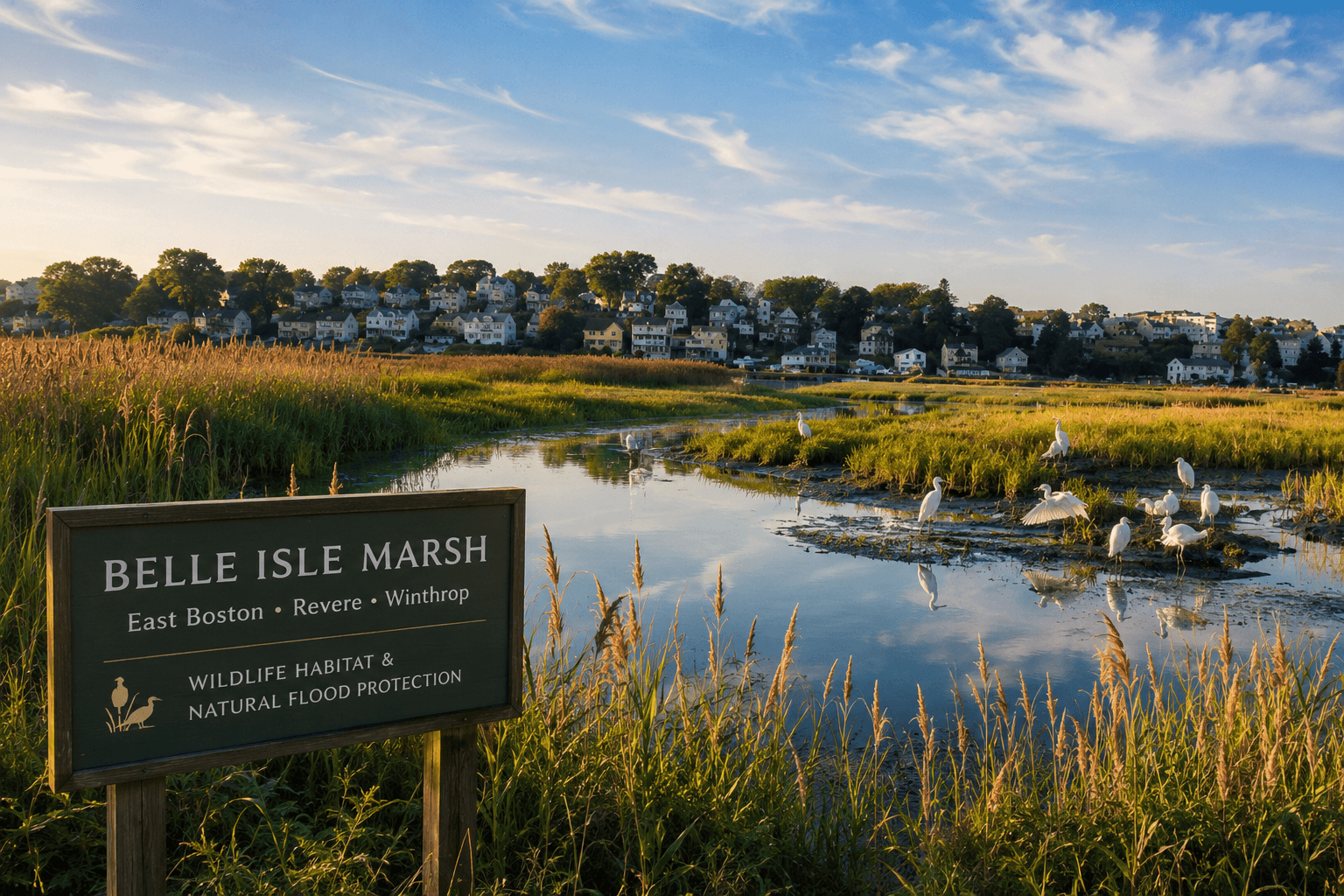
Just beyond Chelsea Creek, where East Boston, Revere, and Winthrop meet the harbor, Belle Isle Marsh feels like a different world. Planes pass overhead, traffic moves nearby, and neighborhoods press close on every side — but inside the marsh, the city gives way to tall grasses, tidal water, birds, and wide-open sky.
Belle Isle Marsh is one of the Boston area’s most important remaining salt-marsh landscapes. The National Park Service describes it as the last remaining salt marsh in the city of Boston, with just over 130 acres of marshland and more than 250 bird species. The U.S. Environmental Protection Agency describes the larger Belle Isle Marsh area as a 359-acre salt marsh spanning Boston, Revere, and Winthrop, located along the Atlantic Flyway, where birders have documented 265 bird species.
For Chelsea-area readers, that means one of the region’s richest natural places is close enough for a short outing. Belle Isle Marsh is not a manicured park in the traditional sense. Its appeal is wilder and quieter: walking paths, marsh views, birdwatching, fishing, jogging, picnicking, and the chance to notice a landscape that still changes with the tides. The EPA notes that the preserve now includes a parking lot and trailhead that provide access to trails through the area.
The Mystic River Watershed Association calls Belle Isle Marsh an important place for both wildlife and people, located within Winthrop, East Boston, and Revere. Its description is simple and useful for first-time visitors: neighbors can walk, enjoy nature, or spend time with family and friends, while the marsh provides habitat for birds, fish, crabs, and mammals. Ospreys nest on high platforms in the marsh, and many endangered birds use the area for food, rest, or nesting during migration.
That mix of everyday access and ecological value is what makes Belle Isle Marsh so special. A visitor may come for a quiet walk or a view from the paths, but the marsh is doing much more than looking beautiful. Salt marshes are working landscapes. They absorb and slow water, support marine life, hold soil in place, and create habitat for species that depend on tidal edges. The Mystic River Watershed Association explains that marshes can act like a sponge, taking in excess water or slowing stormwater to help protect nearby communities from flooding.
That matters for communities around Chelsea Creek, where environmental conditions, flooding risk, industrial land uses, and access to green space are all part of the same local story. Belle Isle Marsh is not only a destination for birders. It is a reminder that natural systems can be part of public infrastructure — helping soften the impact of storms while giving residents a place to breathe, walk, and reconnect with the water.
The EPA makes that climate-protection role clear. Its Brownfields success story says marshes like Belle Isle can help buffer communities against strong winds and waves from hurricanes and other storms. The agency also notes that protecting and restoring Belle Isle Marsh is important as Boston prepares for extreme weather and expected sea-level rise.
The marsh’s story is also one of cleanup and repair. The National Park Service notes that the area once known as Hog Island had a long and changing history, including agriculture, dredged-material disposal, a drive-in movie use, and later industrial activity. The EPA describes how the former Belle Isle Fishing Company property, a 1.6-acre site at the entrance to the marsh, became contaminated with dumped materials after the company closed. Those contaminants included asbestos, petroleum, lead, and polycyclic aromatic hydrocarbons, or PAHs.
The cleanup took years and multiple partners. According to the EPA, the City of Boston took ownership of the property in 1991 with the goal of transforming it into a safe public access point. A $200,000 EPA Brownfields cleanup grant helped support disposal of hazardous contaminants, while the city invested $393,000 and nearly 8,600 cubic yards of contaminated soil were removed. Additional restoration work included breaching constructed dikes to restore tidal flows and planting native salt-marsh vegetation.
Today, that history gives the marsh an added meaning. Belle Isle Marsh is not simply land that was preserved before development arrived. Part of it had to be reclaimed from damage. A place once burdened by contamination now functions as habitat, open space, and a public entry point into one of the region’s most biologically important coastal environments.
For visitors, the best way to experience Belle Isle Marsh is to slow down. Bring binoculars if you have them. Watch the sky, the grasses, the mudflats, and the platforms where birds may gather. Look for movement along the waterline. Notice how the city sounds fade and return. In warmer months, the marsh can feel full of life; in colder months, it can feel stark, quiet, and spacious.
Belle Isle Marsh is wild, but it is not remote. That is its local gift. It gives Chelsea, East Boston, Revere, and Winthrop residents a nearby place to see how nature survives inside an urban region — and how much work it takes to protect it. For a quick walk, a birdwatching stop, or a deeper look at climate resilience close to home, Belle Isle Marsh is one of the most valuable natural escapes in the neighborhood. |
2 Comments
Join the conversation
Spent many afternoons there with my kids spotting birds. You’d never guess you’re just a mile from the airport with all that quiet. Absolutely love having this so close.
Hard to believe how much history there is in that marsh. I remember when it was just old fences and junk, now it’s a whole new spot. Glad they invested in cleaning it up.