Chelsea Residents Can Now Apply for a Free Shade Tree |
The Greening the Gateway Cities program will plant — and help residents care for — free trees on eligible properties, with no application deadline for Chelsea. |
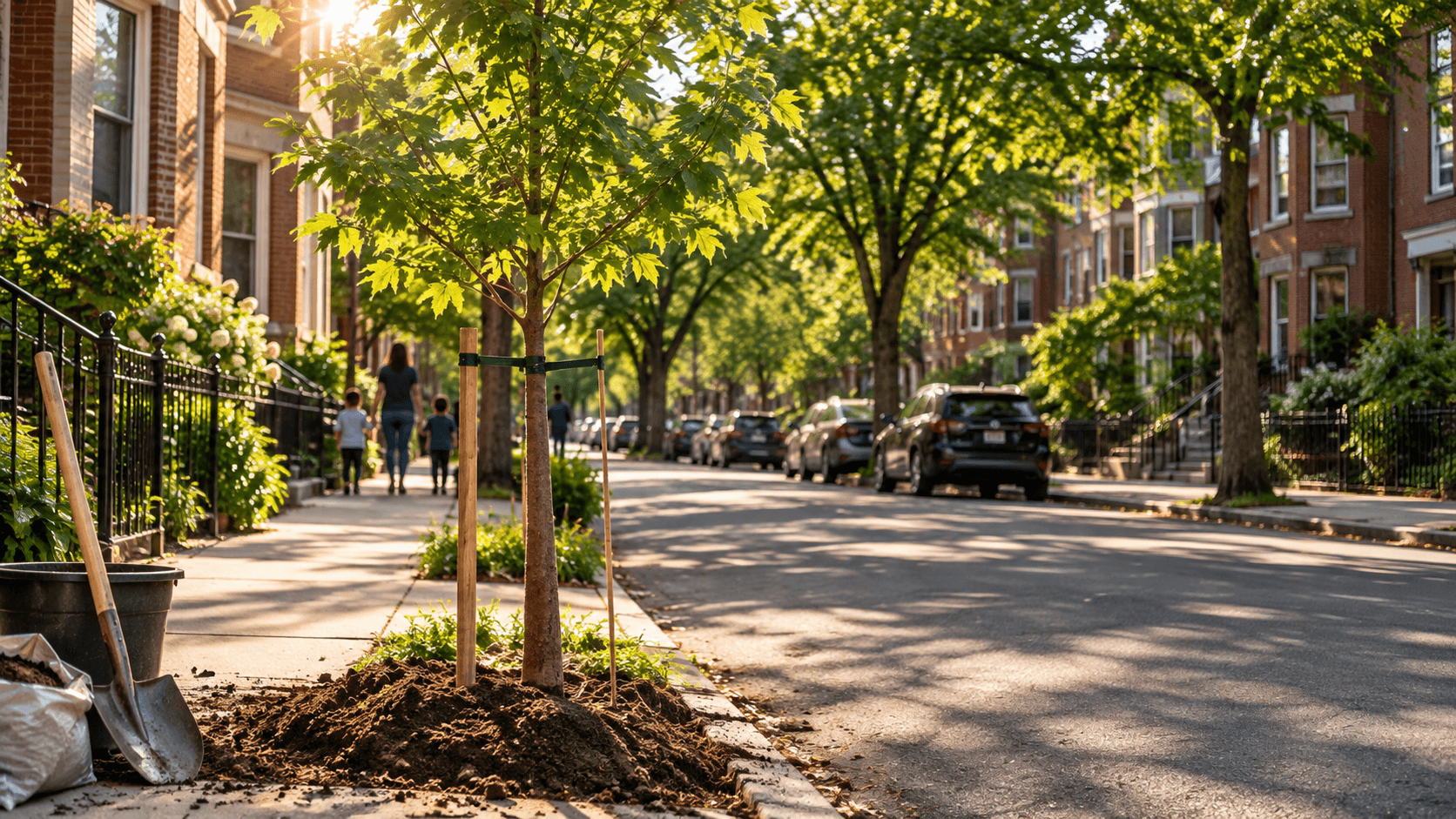
Chelsea households can now sign up for a free shade tree, courtesy of a state program that's ramping up outreach this fall. The Mystic River Watershed Association (MyRWA) announced on September 2 that it's raising awareness of free-tree opportunities across its watershed communities, including the Greening the Gateway Cities (GGCP) Urban Canopy Project, which covers Chelsea, Everett, Malden, and Revere.
The trees themselves come from the state's Greening the Gateway Cities Program, a partnership between the Executive Office of Energy and Environmental Affairs (EEA) and the Department of Conservation and Recreation's (DCR) Urban & Community Forestry Program. Unlike a nearby program for Somerville residents, which has a priority deadline of August 15, sign-ups for Chelsea, Everett, Malden, and Revere are rolling, with no application deadline.
Not every address qualifies. Trees are only planted within a designated planting zone in each city, concentrated in neighborhoods with lower existing tree canopy, older housing stock, and larger renter populations. Chelsea residents can check whether their address falls within the zone using the map on the program's Chelsea page, or by calling the local Chelsea GGCP office directly at 617-626-1459. Planting requests require a property owner's signature for final approval; renters who don't own their home can still request a tree, but need the landlord's written permission, which a program forester can help arrange by providing information for the property owner.
For residents in the zone, the process starts with a site visit: a DCR forester meets with the resident to determine the best location and species for the property, following a "right tree, right place" approach. More than 40 species are available, with shade trees prioritized and only a limited number of evergreens; the program does not plant fruit trees, shrubs, or flowers, since those require pruning practices that work against building a shade canopy. Exact species availability shifts by season depending on nursery stock, and substitutions are sometimes necessary. Trees are planted between 6 and 10 feet tall by DCR crews hired from local communities, and residents do not need to be home for the actual planting, though foresters generally schedule site visits between 7:30 a.m. and 4 p.m., with some early-evening appointments available.
The only cost to residents is a commitment to water their new tree for two years; DCR provides care instructions covering watering, mulching, and pruning. As of an early 2024 program update, Chelsea had already surpassed its original planting goal, with more than 2,500 trees planted against a 2,400-tree target — though the city remains eligible for additional plantings within its zone.
The push comes as MyRWA and its partners highlight the broader benefits of urban trees: shade and cooling for increasingly hot summers, reduced stormwater runoff, improved air quality, and lower home energy costs. Chelsea is one of the Gateway Cities most affected by urban heat, with significant areas of low tree canopy that make it a priority for the program.
Chelsea residents interested in a free tree can sign up through the Greening the Gateway Cities Urban Canopy Project's online form, or call the local Chelsea GGCP office at 617-626-1459 for more information. |
0 Comments
Join the conversation
Be the first to comment
Share your thoughts above.