
Market Basket Floats 162 Apartments Next to Its Chelsea Store |
A conceptual master plan would add two mixed-use apartment buildings and new retail beside the Chelsea commuter rail and Silver Line station. No formal proposal has been made yet. |
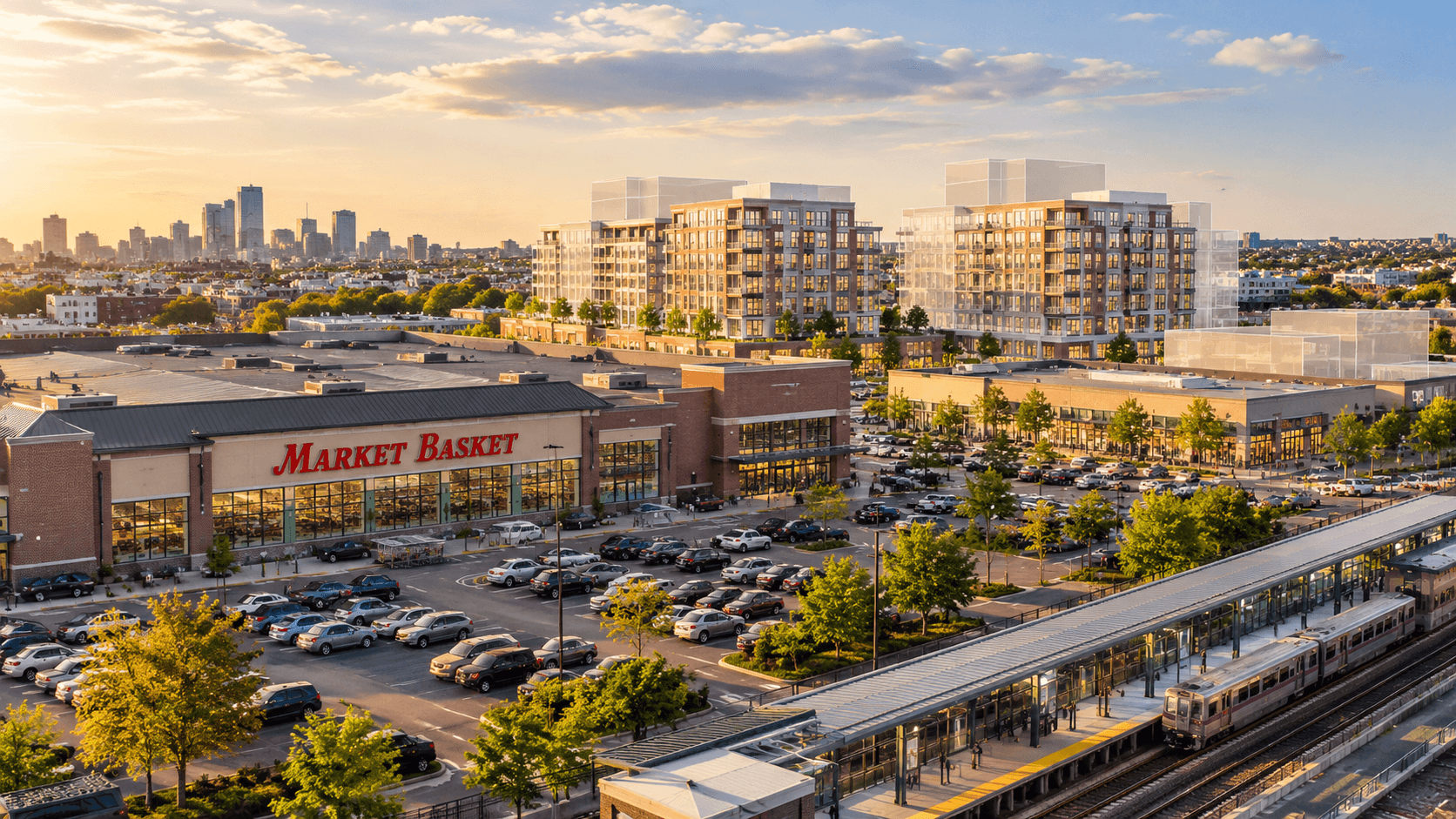
The two lots next to Chelsea's Market Basket don't get much use. One stores snow and plow equipment. The other is mostly grass. Most days, the only visitors are seagulls and pigeons.
That could change. Under a new plan from Market Basket's owners, the lots could one day hold 162 apartments.
Demoulas Super Markets, the company behind Market Basket, has started sharing a 40-page conceptual master plan for its Chelsea property with city officials, the Boston Globe's Power Play newsletter first reported. The newsletter said the company has spent about a year working with City Manager Fidel Maltez, City Councilor-at-Large Leo Robinson and other councilors on ways to bring housing to the site.
What the plan shows
The plan calls for two mixed-use apartment buildings with structured parking. They would go on two mostly empty lots along the Second Street side of the property. Three new retail buildings would go on the opposite side.
That's according to Banker & Tradesman, which got a copy of the plan from the city. Chelsea-based design firm The Architectural Team prepared it.
|
 Chelsea Market Basket in 2009. Photo: Cybah/Wikimedia Commons. Public domain. |
A plan, not a project yet
This is an early concept, not an approved development. No formal housing proposal has been filed. Market Basket would still need a private developer to build the apartments, Maltez told the trade publication. The Globe newsletter reported that the company is expected to look for a developer if the City Council approves the master plan.
Things are moving, though. In an update to the City Council reported Oct. 8 by the Chelsea Record, Maltez said the city has a meeting scheduled with Market Basket's chief executive. He said the company is already talking with several developers about possible proposals and is finalizing the master plan, which will guide future development of the Mystic Mall site.
The site is changing in other ways, too. A new 20,000-square-foot MB Spirits liquor store was set to open there Oct. 9.
The property has reinvented itself before. The enclosed Mystic Mall was built after a massive 1973 fire, replacing the city's old "rag district." Market Basket later turned it into a 130,000-square-foot superstore. Today it's the chain's busiest location.
Why here, and why now
Location is a big part of the pitch. Chelsea's commuter rail station and the end of the SL3 Silver Line sit right behind the store. The 111 and 104 bus routes run nearby.
City rules have changed, too. In June, Chelsea adopted new zoning for the area it now calls West Chelsea. New buildings there no longer need a minimum number of parking spaces. Apartment buildings are allowed by right, and buildings can rise up to 12 stories. The city also lowered the share of affordable units that new multifamily projects must include.
Market Basket president Chuck Casassa said in a statement that the chain has worked closely with the city and that the recent policy changes made a difference.
When the zoning came before the council in March, Maltez said it would replace parking minimums with a Transportation Demand Management program, according to the Record's coverage of that meeting. The name has drawn pushback. A resident questioned calling the area "West Chelsea." Maltez's response: "I think that this was a miscalculation on our part."
Maltez has argued that Chelsea's old rules pushed developers to neighboring cities. From 2020 to 2025, housing permits grew 31% in Chelsea, compared with 59% in Everett and 228% in Revere, according to research the Globe newsletter cited.
"We see development as a means to an end," Maltez said. The city needs new tax revenue for services, he explained, and residents want more housing of every kind, from income-restricted to market-rate. He added that the city would consider long-term tax breaks to help projects get built.
On a walk past the empty lots, he put it more simply: "Pigeons don't pay taxes."
What to watch
For now, the plan exists only on paper. The real details will come if a developer signs on and files a formal proposal. That's when residents will learn what the master plan doesn't answer yet: the mix of apartments, the rents, how many units would be income-restricted, and when, or whether, construction would start. |
0 Comments
Join the conversation
Be the first to comment
Share your thoughts above.