
New Logan-Area Pollution Monitoring Could Add to What We Know About Air Quality Around Chelsea |
Revere is about to get a year of ultrafine-particle monitoring near Logan Airport — but Chelsea has its own, older history with this exact kind of data, and the new numbers could sharpen the picture for both cities. |
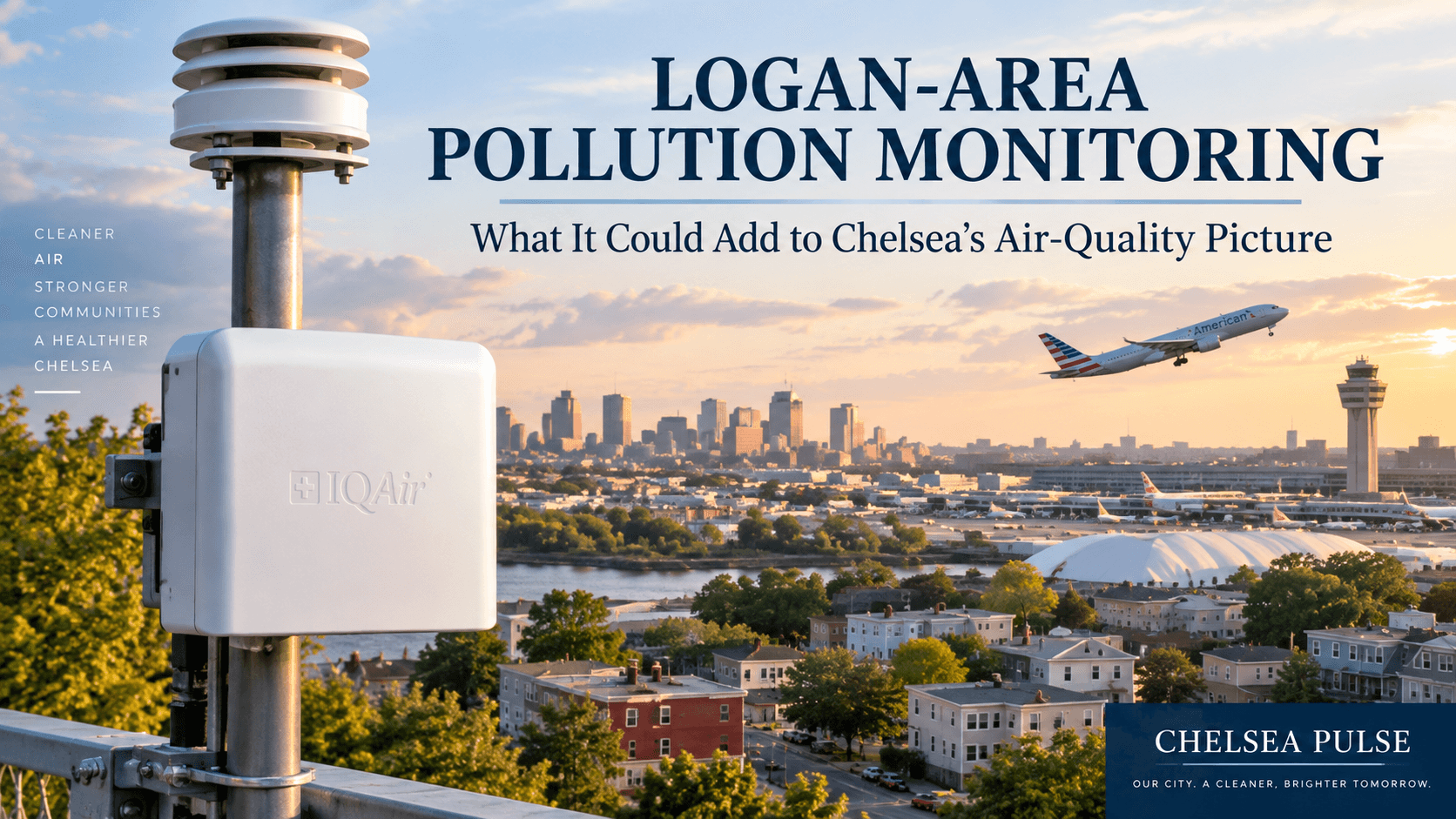
Revere is getting a new set of eyes on the air. The Massport Community Advisory Committee, led by Executive Director Aaron Toffler, is preparing to install a state-of-the-art monitor to measure ultrafine particulate matter — UFPs — from planes descending into Logan International Airport, as well as from car and truck traffic. The exact site hasn't been finalized, but Toffler says it will likely land in Beachmont, the Revere neighborhood closest to the airport. Massport, which funds the MCAC, is covering the roughly $15,000 cost, and Air Partners, a consulting group from Olin College's engineering program, will help pick the location and analyze the results. The monitor is expected to stay in place for about a year to capture seasonal variation, with readings posted daily on the MCAC's website.
Toffler was careful about what the data can and can't prove. "I would not be able to draw a straight line of causation between ultra fine exposure and sickness," he said, "but we do know that ultra fines get into your body — they're smaller than the particles that are currently regulated by the Clean Air Act, and so they get deeper into your body and cross into your bloodstream and cause health problems in that way." (The Revere Journal's own transcription of this quote elsewhere renders the same law as the "Clean Air Impact," which appears to be a transcription slip rather than a second, different law — the rest of the quote clearly refers to the Clean Air Act.) He said a longer-term goal is building a network of similar monitors nationally to push the EPA toward regulating UFPs, which currently aren't covered under the Clean Air Act at all.
Chelsea isn't starting from zero on this question. A peer-reviewed study of homes near Logan documented a clear ultrafine-particle spike in Chelsea households during winds blowing from the airport's direction, and a separate study used a monitor atop a building in Chelsea, about 4 kilometers from Logan, to examine how UFP concentrations changed in relation to pandemic-era flight reductions. On the regulatory side, the EPA installed its own air monitor in Chelsea's Highland Park, near Chelsea Creek, in 2021, after Sen. Ed Markey and Rep. Ayanna Pressley pushed for it during the city's outsized early COVID-19 wave. And between 2023 and 2025, GreenRoots and Northeastern University blanketed the city with more than 80 hyperlocal sensors as part of a project called iSUPER, whose public dashboard includes a dedicated layer specifically tracking ultrafine particles, block by block.
Revere isn't entirely absent from that same regional picture, either — the iSUPER dashboard already includes a separate "Revere sensors" layer alongside its Chelsea network. But per the iSUPER project's own team, Chelsea and Brookline are the two "core partners" hosting a dense, co-designed sensor network built specifically around each community's air-quality questions; Revere and Boston are described only as partnering on other aspects of the project. In practice, that leaves Chelsea with a more established, purpose-built monitoring layer than Revere currently has.
What Chelsea's existing studies didn't do is run continuously, in public, for a full year the way Revere's new MCAC monitor is designed to. That's the piece the new project could add: a longer, more targeted dataset that — if Toffler's stated goal of comparing results "with other surrounding communities" comes through — could eventually be set directly against Chelsea's own numbers, sharpening exactly how much of what Chelsea already knows about its air traces back to the airport across the creek. |
0 Comments
Join the conversation
Be the first to comment
Share your thoughts above.